TLDR
Good two part horn harmony arranging starts with two playable melodic lines, not a lead line copied at a fixed interval. Use thirds and sixths when they support the chord, but change to unison, octaves, held tones, contrary motion or a small counterline when those textures make the riff clearer. Sketch in concert pitch, inspect each part separately, transpose only after the music works, and test the result with the rhythm section.
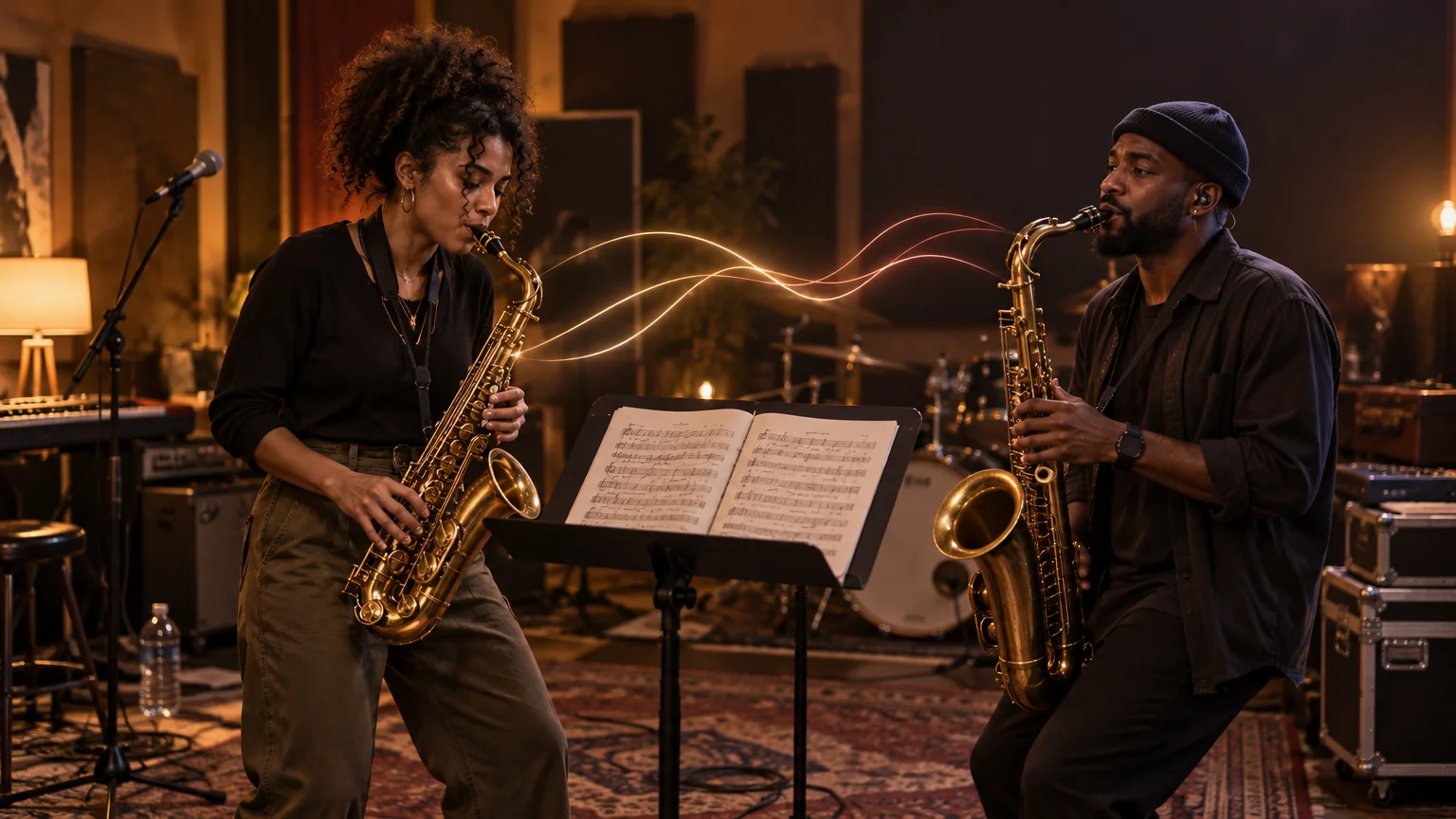
In pop, funk, soul, R&B, reggae and hip-hop, “two horns” can mean trumpet and tenor sax, trumpet and alto sax, two saxophones or another mixed pairing. It does not necessarily mean two French horns. Whatever the instrumentation, the arranging problem is the same: the lead must communicate the hook while the second voice strengthens the harmony without turning into an awkward trail of automatic thirds.
The decisive question is not, “What interval goes under this note?” It is, “What job should the second player perform here?” Formal arranging curricula treat two-part writing as a combination of intervals, voicings, voice leading, unison textures, punches and countermelodies rather than one permanent harmonization formula. Berklee’s Arranging for Horns course, for example, explicitly includes two-part couplings among its arranging topics.
Five textures available to a two-horn section
| Texture | What it does | Where it usually helps |
|---|---|---|
| Unison | Both players perform the same concert-pitch line. | Fast riffs, strong entrances, pickups and rhythmically important hooks. |
| Octaves | Both parts share the melodic shape in different registers. | Broad hooks that need width without additional harmonic information. |
| Parallel harmony | The second part follows the lead in intervals such as thirds or sixths. | Short chordal phrases where both lines remain comfortable and accurate. |
| Oblique or contrary motion | One voice holds or moves in the opposite direction while the other continues. | Chord changes, sustained tension, smoother voice leading and phrase expansion. |
| Lead plus counterline | The second voice answers, sustains or fills space around the main idea. | Long lead notes, vocal gaps and arrangements that need motion without constant block harmony. |
A good eight-bar passage may use all five. The horns might enter in unison, open into sixths, hold one voice through a chord change and return to unison for the final stab. That change of texture creates shape. It also stops the harmony part from sounding like a software-generated copy of the melody.
A workflow for two part horn harmony arranging
1. Define the musical job
Decide whether the figure is a hook, vocal answer, background pad, rhythmic punch, transition or solo accompaniment. A hook usually needs a strong top line and an unmistakable rhythm. A background should support the foreground without competing for attention. A punch may need only unison or octaves because harmonic detail matters less than timing and impact.
2. Write a convincing lead line first
Make the lead work by itself. Sing it, play it and reduce it to its essential rhythm. If it does not make sense as a one-note line, adding harmony will rarely rescue it. The lead instrument should be the one whose register, tone and attack best communicate the idea; it does not automatically have to be the higher-pitched instrument for the entire arrangement.
3. Mark the harmonic anchors
Label the chord under each important attack, especially the first note, long notes, syncopated accents and phrase ending. Also inspect the bass line. A theoretically available chord tone can still muddy the arrangement if it doubles a prominent bass note in an unhelpful register.
In blues-influenced writing, thirds and sevenths are particularly useful guide tones because their movement helps define harmonic direction. Open Music Theory demonstrates how smooth connections between those tones can clarify blues harmony. Its blues-harmony discussion is a useful reference when the chords matter more than a fixed parallel shape.
4. Build a second melody
Start the harmony part on a suitable chord tone, then ask where that player naturally wants to move. Prefer steps, repeated notes and manageable skips. A note may fit the chord vertically yet produce a clumsy line when connected to the notes around it. Play the second part alone; if it sounds like a random collection of leftovers, rewrite it.
5. Change texture instead of forcing an interval
When a third creates an ugly leap, hold a common tone, switch to a sixth, move in contrary motion or join the lead in unison. On quick pickups, chromatic approaches and tightly syncopated figures, unison is often cleaner than harmonizing every passing note. Harmony can enter on the destination note after both players have articulated the pickup together.
6. Prepare and rehearse real parts
After the concert-pitch sketch works, prepare correctly transposed parts with articulations, dynamics, rests, breaths, rehearsal marks and cues. Two-horn arranging and individual transposed parts are treated as connected practical tasks in university jazz-arranging study, for good reason: an idea is not finished when it exists only in the arranger’s concert score.
How to choose intervals without getting trapped by them
Thirds and sixths are useful because they readily produce familiar chordal color. Neither interval is automatically safe. A diatonic third may introduce an unwanted extension, conflict with the chord quality or push one player into a weak register. A sixth can sound open and vocal, but it may separate the players too far if the registers are already wide.
- Use thirds when close harmony supports the style and both lines remain singable.
- Try sixths when thirds feel crowded or when the lower line needs a smoother route.
- Use fourths and fifths deliberately for a more open, less conventionally chordal sound.
- Reserve seconds and sevenths for intentional tension; place and resolve them clearly.
- Choose unison or octaves when rhythmic force, speed or harmonic ambiguity makes added notes a liability.
Do not harmonize every passing tone merely because it is present. If the lead moves between two structural notes, the second part can hold, move later or use its own passing tone. Pickups often work best in unison because they aim the ear toward the accented chord tone. At phrase endings, simplify: a clean shared note can land harder than a decorative interval.
A four-bar concert-pitch example
Consider this original four-bar R&B/funk figure. The chord progression is Dm7 | G7 | Cmaj7–A7 | Dm7–G7. The pitches below are concert pitches without fixed octaves, so the final register should be chosen for the actual players.
| Bar | Lead horn | Second horn | Arranging choice |
|---|---|---|---|
| 1: Dm7 | F–A–C–A | D–F–A–F | Chord-aware thirds establish the sound clearly. |
| 2: G7 | F–G–B–D | D–D–D–B | The second horn holds D while the lead moves, creating oblique motion instead of automatic parallels. |
| 3: Cmaj7 to A7 | E–G–C–C-sharp | C–E–G–A | The parts follow the chord change while each retains a compact melodic shape. |
| 4: Dm7 to G7 | D–F–G | A–D–G | The lower voice corrects by smooth chord tones, then both players meet on the final unison G. |
The example begins conventionally so the audience understands the harmony. Bar two creates contrast with a held tone. Bar three responds to the changing chords rather than preserving one interval. Bar four avoids a forced parallel solution and spends its strongest structural moment—the final attack—in unison.
Rhythm will determine whether these notes feel like a horn line rather than an exercise. Try short attacks on the first three bars, leave a visible breath before bar four, and make the final G a coordinated stab with the rhythm section. If the lead or harmony crosses registers awkwardly, change the octave or redistribute the voices rather than defending the example mechanically.
Adapt the writing to the groove
In funk and soul, precise releases are as important as attacks. Short harmony bursts can frame a vocal while unison figures lock with the bass and drums. Contemporary R&B often benefits from fewer notes, warmer sustained intervals and deliberate gaps around the singer. Hip-hop and DJ-plus-sax settings may need one memorable motif rather than continuous section writing.
Reggae makes space especially important. Horn answers should reinforce the song’s hook without crowding the bass, drums or offbeat guitar and keyboard parts. For a deeper treatment of that rhythmic relationship, see how space and repetition shape reggae horn lines.
If the original riff is already recognizable, preserve its rhythmic identity before making adventurous harmonic changes. When the underlying chords are changing too, use the process in reharmonizing a horn line without losing the hook to separate what defines the riff from what can safely move.
Concert pitch and transposed parts
Sketching in concert pitch lets you compare both sounding lines directly. The performance parts must then account for the players’ transposing instruments. Yamaha identifies soprano and tenor saxophones as B-flat instruments and alto and baritone saxophones as E-flat instruments. Yamaha’s saxophone transposition guide explains the difference between written and sounding pitch.
| Common instrument | Typical transposition from concert pitch | Practical note |
|---|---|---|
| B-flat trumpet | Write a major second higher. | Confirm the specific trumpet and the player’s preferred register. |
| Tenor saxophone | Write a major ninth higher. | This is a major second plus an octave in standard treble-clef notation. |
| Alto saxophone | Write a major sixth higher. | Check that the resulting written line sits well for the individual player. |
| Baritone saxophone | Write a major thirteenth higher. | This is a major sixth plus an octave in standard treble-clef notation. |
These formulas address standard written transposition, not musical comfort. Register, dynamics, timbre, experience and equipment all affect whether a line is practical. Give the players the actual part, not only chord symbols and a verbal instruction to “play a third below.”
The rehearsal test
A chart can be harmonically correct and still fail onstage. Rehearse it with the rhythm section at performance tempo and listen for attacks, releases, breath placement, balance and register. The harmony player should not disappear on low notes or dominate the lead on bright upper notes. Check the figure through the monitoring setup the musicians will actually use.
- Can each player perform the line cleanly without an emergency breath?
- Does the lead remain recognizable when both horns enter?
- Does every long or accented note agree with the active chord?
- Can the second part be played musically on its own?
- Are articulations and releases written rather than left to guesswork?
- Does the figure leave enough space for the vocal, bass and drums?
- Would unison make any difficult passage tighter and more effective?
A practical next exercise
Take one four-bar riff and arrange it three ways. Make the first version mostly thirds and sixths. Use unison and octaves at structural moments in the second. In the third, give the harmony voice held notes, contrary motion and one short counterline. Record all three with the same tempo and rhythm-section pattern.
Keep the version that makes the hook and groove land best—not the one with the most harmony. That is the central discipline of two-part writing: every note in the second voice must earn its place as melody, harmony or rhythm. Thirds remain valuable, but they are only one color in a much more useful arranging palette.